Philippe Lignac - discussing sales techniques, sales negotiations, sales management and other business topics

Apr 11, 2017

Sales Discipline : Good to great - review

11 April Posted by Philippe Lignac , No comments
Review - Good to Great from by Jim Collins
Image result for good to great
“Good to Great” is one of those books I kept seeing everywhere – in articles, blogs, referenced in interviews and on top business book lists. When I finally re-read it (in 2015) I have found a very interesting book.

Cons:
1) It's outdated. Some of the companies that are praised in this book are already bankrupt or just around the corner from bankruptcy/ government bailout. This book was published in 2001, and no word of Apple, Google, Amazon, Facebook, etc, so take it for what it’s worth.
2) The main problem of this book is that it's going backwards from results to reasons. It takes a “successful” company and tries to explain how its success came from some master plan that was well crafted. Always a dubious exercise.
3) Nothing in this book relates to the global economy, millennial generation or the mobile retail revolution. Because this book was published in 2001, it means that there is a relevant expiration date.

Pros:

1) I liked the chapter about level 5 management, nothing new here but refreshing ideas about humility and open-minded leaders.
2) I liked the hedgehog chapter about focusing your business on what you love and what you are good at to help maximize profits.
3) Positive lessons about running a healthy company that works as a team.

Bottom line:
Fun read. You can’t apply every lesson from this book to today economics but reading this book will help you stop in your tracks and make you think "can I do this better?".  

For my day job, the most important points highlighted are: Discipline, enthusiasm and credibility 

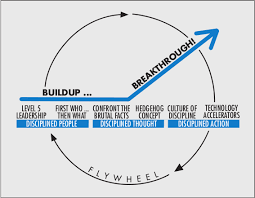
Level 5 Leadership:

  • “Level 5 leaders channel their ego needs away from themselves and into the larger goal of building a great company. It’s not that Level 5 leaders have no ego or self-interest. Indeed, they are incredibly ambitious— but their ambition is first and foremost for the institution, not themselves.”
  • “It is very important to grasp that Level 5 leadership is not just about humility and modesty. It is equally about ferocious resolve, an almost stoic determination to do whatever needs to be done to make the company great.”
  • “Ten out of eleven good-to-great CEOs came from inside the company, three of them by family inheritance. The comparison companies turned to outsiders with six times greater frequency— yet they failed to produce sustained great results.”
  • “Level 5 leaders look out the window to apportion credit to factors outside themselves when things go well (and if they cannot find a specific person or event to give credit to, they credit good luck). At the same time, they look in the mirror to apportion responsibility, never blaming bad luck when things go poorly.

First Who, then What:

  • “I don’t know where we should take this company, but I do know that if I start with the right people, ask them the right questions, and engage them in vigorous debate, we will find a way to make this company great.”
  • “We found no systematic pattern linking executive compensation to the process of going from good to great. The evidence simply does not support the idea that the specific structure of executive compensation acts as a key lever in taking a company from good to great.”
  • “To be ruthless means hacking and cutting, especially in difficult times, or wantonly firing people without any thoughtful consideration. To be rigorous means consistently applying exacting standards at all times and at all levels, especially in upper management. To be rigorous, not ruthless, means that the best people need not worry about their positions and can concentrate fully on their work.”
  • How to be rigorous:
  • When in doubt, don’t hire, keep looking
  • When you know you need to make a people change, act: ” The good-to-great companies showed the following bipolar pattern at the top management level: People either stayed on the bus for a long time or got off the bus in a hurry. In other words, the good-to-great companies did not churn more, they churned better.”
  • Put your best people on your biggest opportunities, not your biggest problems

Confront the Brutal Facts but Never Lose Faith:

  • “The moment a leader allows himself to become the primary reality people worry about, rather than reality being the primary reality, you have a recipe for mediocrity, or worse. This is one of the key reasons why less charismatic leaders often produce better long-term results than their more charismatic counterparts.”
  • How to encourage a climate of truth:
  • Lead with questions, not answers. Don’t assume you know what’s best.
  • Engage in dialogue and debate, no coercion.
  • Conduct autopsies and without blame
  • Build “red flag” mechanisms: “If you raise your hand with your red flag, the classroom will stop for you. There are no restrictions on when and how to use your red flag; the decision rests entirely in your hands… Your red flag can be used only once during the quarter.”
  • “This is a very important lesson. You must never confuse faith that you will prevail in the end— which you can never afford to lose— with the discipline to confront the most brutal facts of your current reality, whatever they might be.”
  • “Spending time and energy trying to “motivate” people is a waste of effort. The real question is not, “How do we motivate our people?” If you have the right people, they will be self-motivated. The key is to not de-motivate them. One of the primary ways to de-motivate people is to ignore the brutal facts of reality.”

The Hedgehog Concept (Simplicity within three circles):

  • “The fox knows many things, but the hedgehog knows one big thing.””
  • More precisely, a Hedgehog Concept is a simple, crystalline concept that flows from a deep understanding of the intersection of the following three circles:
  • What you can be the best in the world at (and, equally important, what you cannot be the best in the world at).
  • What drives your economic engine. The single denominator— profit per x— that had the greatest impact on their economics. (It would be cash flow per x in the social sector.)
  • What you are deeply passionate about.

A Culture of Discipline:

  • “Build a culture full of people who take disciplined action within the three circles, fanatically consistent with the Hedgehog Concept.”
  • “The good-to-great companies built a consistent system with clear constraints, but they also gave people freedom and responsibility within the framework of that system. They hired self-disciplined people who didn’t need to be managed, and then managed the system, not the people.”
  • “When you have disciplined people, you don’t need hierarchy. When you have disciplined thought, you don’t need bureaucracy. When you have disciplined action, you don’t need excessive controls. When you combine a culture of discipline with an ethic of entrepreneurship, you get the magical alchemy of the great performance.”

Technology Accelerators:

  • “This brings us to the central point of the chapter. When used right, technology becomes an accelerator of momentum, not a creator of it.”

The Flywheel and the Doom Loop:

  • “Sustainable transformations follow a predictable pattern of buildup and breakthrough. Like pushing on a giant, heavy flywheel, it takes a lot of effort to get the thing moving at all, but with persistent pushing in a consistent direction over a long period of time, the flywheel builds momentum, eventually hitting a point of breakthrough.”

From Good to Great to Built to Last:

  • “Bad BHAGs, it turns out, are set with bravado; good BHAGs are set with understanding. Indeed, when you combine a quiet understanding of the three circles with the audacity of a BHAG, you get a powerful, almost magical mix.”
  • “Indeed, the point of this entire book is not that we should “add” these findings to what we are already doing and make ourselves even more overworked. No, the point is to realize that much of what we’re doing is at best a waste of energy. If we organized the majority of our work time around applying these principles, and pretty much ignored or stopped doing everything else, our lives would be simpler and our results vastly improved.”


Philippe Lignac Sales Director MDSL interview at the EMM event London


Philippe-Lignac-Sales-Director-MDSL
Philippe Lignac sales director MDSL interview for TV


Philippe-Lignac-Sales-Director-MDSL
Philippe Lignac Sales Director MDSL interview at the EMM event London


Philippe-Lignac-Sales-Director-MDSL
Philippe Lignac Sales Director MDSL speaking at the EMM event London


<script type="text/javascript" src="https://platform.linkedin.com/badges/js/profile.js" async defer></script>


Apr 10, 2017

Sales Methodology or Sales Process?

10 April Posted by Philippe Lignac , No comments


Sales Methodology or Sales Process?


Image result for sales process sales methodology


When someone asks me "which sales methodology are you using?" - my favorite answer is “all of them”. In truth, there is no silver bullet in sales methodology. However, before choosing a sales methodology you probably need to clearly define your sales process.

A documented sales process serves as a guideline to help sales reps determine proper next steps to bring prospect through the buyer’s journey to that final sale.

Unlike a sales process, a sales methodology isn't applied to the entire sales cycle; rather, it focuses in one area of a sales process and builds unique approaches based on a business’s goals, culture, and values. It’s more of a strategy.

When it comes to sales methodologies, there are 9 most popular methodologies companies use: 
  •  The Challenger Sale
  •  SPIN Selling
  •  N.E.A.T. Selling
  •  The Sandler System
  •  Solution Selling
  •  Inbound Selling
  •  MEDDIC
  •  Conceptual Selling
  •  SNAP Selling
Many of the sales training methodologies started with a specific focus. For example, SPIN Selling started with a focus on the discovery and a questioning methodology to understand and probe into customer problems. Miller Heiman’s Large Account Selling originally focused on expanding share and growing presence in large accounts.

Some methodologies tend to be focused more heavily on a certain part of the sales process. For example, Challenger focuses more on the very front end of the process, providing insights that motivate the customer to take action and change. Some methodologies focus on negotiation which occurs at the end of the sales process.

My strategy is to take the best from several methodologies, creating my own unique methodology. I know a number of companies that have purposefully leveraged a number of methodologies -- one year they might learn one, two years later another, two years later yet another. They then incorporate the best pieces into what works for them.

Sales process or methodology?
So do we need a sales process or a sales methodology? The definitive answer is, “Yes, we need both.” Make sure to invest the time in understanding and defining your own sales process. It’s the cornerstone to your success and differentiation. 
Overlay that, and sharpen the execution of your sales process with a great sales methodology. But make sure the methodology is integrated into your sales process. 
Don’t forget, you sustain your investment in any sales training by integrating it into your systems, processes, tools, and most importantly, coaching strategies."

Dec 18, 2016

Channel Partner Program to Succeed in the new world of Digital Transformation

18 December Posted by Philippe Lignac , , No comments

The Channel Partner Program to Succeed in the new world of Digital Transformation


Let’s face it, the digital revolution is redefining business models, go-to-market strategies, sales tactics and much more across every industry and vertical.

With growing complexities in the technology stack, businesses in every vertical are unsure of what they need and how to evolve their businesses to stay competitive in the digital-first era.

Priorities and goals are constantly shifting, leaving technology up for debate at each stage.

The channel team I am managing has collaborated with our sales, business development and engineering teams to see the complete picture and determine how we can best set our partners up for success and help them drive impact for whatever is next in a customer’s agenda.

Our partner program has been adapted to equip our partners with the tools, training and support needed to create critical long-term value for their customers who want to thrive in this digital revolution.

Our ecosystem of partners is structured in two tiers: At the top are our most strategic partners. This level gains access to resources that provide strategic support needed for partners to incorporate our solution into their digital story so that our mutual customers can achieve maximum value:

·  Sales and Pre-sales Enablement: Through customized, in-person    training and enablement programs we’ll build sales and pre-sales champions within our partners and drive a deeper understanding of our solution. These advanced level “Masters” training courses will ensure that we’re delivering optimal value to our joint customers as they undergo their digital transformations.
· Services Implementation Training: Completion of this hands-on practical training will enable our partners to build advanced consulting services and have a more direct relationship with our customers. Once certified through this program, our partners will be able to work directly with our customers to drive more differentiated offerings based on customers’ unique needs.
· Dedicated Sales Engineering and Field Channel Manager   Support: We’re heavily investing in growing specialized teams that offer support at every stage of our partnerships – from laying the foundation of each partnership and aligning with channel sales resources to dedicated channel SE teams that will work hand in hand with partner’s technical teams to develop joint offerings.
·   Exclusive Rebate Program: Our partners will receive an agreed rebate to enable additional investments into building a long-term, strategic solution practice.

In addition to the benefits listed above, partners will have access to following resources that are available to all our partners:

·  Online TrainingAll partners are eligible for our “Kick Starter” online courses, which provide an ideal introduction to our solutions. Both sales and pre-sales partner teams will have access to this 101-level content for a strong start with mutual customers and an accelerated path to profitability.
· Margin Guaranteed: Unlike most deal registration programs, we guarantee our margins by paying our partners an agreed percentage of the Total Contract Value. This results in greater predictability in joint opportunities.
·   Sales and Pre-sales SupportOur sales and pre-sales teams will work closely with our partners and mutual customers to assist with proof of concept, Business Value Adds (BVAs) and joint planning.

Philippe-Lignac-Sales-Director-MDSL
Philippe
 Lignac sales director MDSL at Procurecon Amsterdam


We are constantly improving our partner program to response to the technical complexities and hurdles our customers are facing in the digital revolution. Working more collaboratively with our top partners and sharpening alignment with their technical talent will establish a strong network of global technology leaders our customers can call upon to help realize their digital transformation visions. 


Now if we look across other companies,

What the Best SaaS Partner Programs Have in Common


  • All companies offer co-marketing support for their partners.
  • All companies offer a partner portal to help manage their partner relationships.
  • Most programs are free to join. Only a few large enterprise programs (Salesforce, HubSpot, and PayPal) have partner fees.
  • Two-thirds of partner programs pay partners for referrals, although frequently this is only offered to higher-tier partners. Partner programs that don’t offer compensation for referrals are usually smaller companies.
  • Likewise, two-thirds of SaaS companies list their partners publicly, although once again this benefit is frequently only offered to higher-tier partners.
  • All but a handful of SaaS partner programs provide some form of sales training, although only half provide hands-on sales support.


Looking over the list of the best SaaS partner programs, a few common themes jump out:
            Overall, each of the partner programs offered a mix of services for partners, while utilizing the strengths and weaknesses of both parties involved.

            Philippe Lignac sales director MDSL with Eli Lilly


            Philippe-Lignac-Sales-Director-MDSL
            Philippe Lignac sales director MDSL


            Philippe Lignac sales director MDSL talking at Procurecon Amsterdam


            Some great examples, I picked up from looking at their websites

            1. Atlassian’s Solutions Partner Program
            2- Slack’s Communication Platform Partner Program
            3- Zendesk Customer Service and Engagement Platform
            4- Optimizely’s Conversion Rate Optimization Software
            1-Atlassian makes collaboration tools for teams of all sizes, including the popular issue management tool Jira and knowledge base tool Confluence. Atlassian offers a tiered Solution Partner Program—all tiers include partner portal access, access to certification and training programs, a listing on Atlassian’s partner directory, and free access to Atlassian products for internal use. Higher tiers also include referral bonuses, product discounts, and a dedicated channel manager. Partners can graduate to higher tiers by meeting sales goals and completing Atlassian’s training programs.
            Key Takeaway: Creating tiers based on performance means that you can reward partners based on their contributions to your business.


            2-Slack provides a well-run integrations program for partners, working with over 1,000 SaaS products to help users be more efficient and productive in their communications. Their partner list includes some big names, like Salesforce and Google, so partners can be sure the program is well run.
            Slack’s partner program isn’t open to just anyone – to join the program, potential partners must submit a complete application and be accepted into the partner program. The benefits for integration partners are huge, with access to 9 million weekly active users and a listing in the public Slack apps directory to help users find the functionality they’re looking for. To help support app developers, Slack provides partners with detailed documentation on their API and platform.
            Key Takeaway: Partner applications help ensure customers can rely on your partners, especially for mission-critical products.

            3- Zendesk’s Customer Service and Engagement Platform
            Zendesk helps companies turn interactions into lasting relationships through their integrated platform of customer support, knowledge base, and live chat tools.
            Zendesk’s partner program ticks a lot of boxes, offering benefits across three different tiers: Referral Partner, Solution Provider, and Business Service Provider. Technology partners can build apps to integrate with Zendesk as well. All partners receive access to online sales training, commissions for referrals, a dedicated partner manager, and more. Higher tiers are eligible for instructor-led product training, marketing funds, and joint business planning. Zendesk also maintains a public directory of Zendesk client services & partners.
            Key Takeaway: Clear documentation on your partner programs can help partners understand how they will benefit, especially when you offer multiple different programs.

            4- Optimizely’s A/B testing software allows SaaS companies to take the guesswork out of product development and marketing, making it easy to run and manage A/B tests to optimize conversions and product experience.
            Partnering with Optimizely includes comprehensive developer support and enablement, a custom sandbox for experimentation, and access to Optimizely’s partner community and certifications through Optimizely Academy. Co-marketing resources are provided for partners along with a dedicated partner manager and joint sales collateral to help with sales enablement. All partners are listed in a public directory of Optimizely partners, and Optimizely will pay a 10-20% commission on the first year of customer revenue.
            Key Takeaway: Offering a certification program can help increase your partners increase trust with their own customers.

            <script type="text/javascript" src="https://platform.linkedin.com/badges/js/profile.js" async defer></script>


            Dec 1, 2016

            Negotiation skills - "start with no" Review

            01 December Posted by Philippe Lignac , No comments

            Philippe-Lignac: Negotiation skill - "Start with No"

            Image result for negotiation skill


            Negotiation management skills are perhaps the most important professional competency for any executive. Unfortunately, they are also the most widely neglected. Why is that? Fear, particularly the fear of failure and rejection, convinces all of us to behave and perform at suboptimal levels. 

            Instead of maximizing results, we often times make poor decisions leading to unnecessary compromise. 

            Section 1: Mindset

            Contrary to the status quo, the Camp System of negotiation does not hold stock in the theory of “win-win”. Known as the contrarian perspective, this section asks you to consider, what is truly “REQUIRED” in order for a negotiation to take place? Is compromise required? Are power and leverage, what really gives you the authority in negotiation? How can you reduce your feelings of vulnerability no matter who you’re negotiating with?
            Picture of Philippe Lignac MDSL sales director in Orlando

            Philippe-Lignac-Sales-Director-MDSL
            Philippe Lignac in Orlando
            Section 2: Mission and Purpose
            Most negotiators are so concerned about their own interests, they miss the opportunity to spend time answering the questions, “what are we going to provide the other party, and how will we provide it?” Or even worse, we make the assumption it goes without saying and never ask for confirmation and validation. Mission and Purpose empower us to ask for every decision throughout the life of the engagement. Without it, we’re guessing and potentially leaving money on the table.

            Interview of Philippe Lignac Sales director MDSL at EEM London.
            Mobile event for a large corporation.

            Philippe-Lignac-Sales-Director-MDSL
            Philippe Lignac at EMM London


            Philippe Lignac with Durvin Sandiford at London event


            Section 3: Behaviors
            How do you identify what to say, and how to say it? The negotiator's ability to communicate effectively, even in the most contentious or high stakes negotiation, can make all the difference in the world. The behavioral skill sets in this section are designed to keep you safe while uncovering the motivations and challenges the other party wishes to solve. How to ask the right question at the right time is habitual amongst the finest negotiators in the world.
            Philippe-Lignac-Sales-Director-MDSL
            Philippe Lignac Interview for TV


            TV Interview with Philippe Lignac Sales director MDSL


            Section 4: System Structure
            In this section of the book, they bring everything together and help you master the discipline of preparing, executing, and debriefing using the Camp System’s proprietary Checklist and Log process. Depending on what we already know, or more importantly don’t know, there are ways of identifying and setting the right agenda. The negotiator’s ability to identify what we want from each engagement is both critical and necessary to reach optimal outcomes.
            Philippe Lignac in Tokyo - Sales director MDSL

            Philippe-Lignac-Sales-Director-MDSL
            Philippe Lignac in Tokyo


            Philippe Lignac Sales Director MDSL in Tokyo for the customer's meetings
            Philippe-Lignac-Sales-Director-MDSL
            Philippe Lignac Sales Director MDSL with team